Two years have passed since Hurricane Milton carved its name into Florida's memory, but I can still feel the humid electricity in the air that October afternoon. I was hunkered down in my gaming den in Orlando, a triple-monitor fortress where I usually spent my days reverse-engineering boss mechanics and speedrunning open-world maps. Instead, I found myself refreshing storm trackers and scrolling through an endless feed of panic. The outside world had transformed into a survival game with no pause button. As the wind howled like a thousand overclocked graphics cards, one particular piece of online content froze me in place: an image of Walt Disney World submerged in murky brown water, Cinderella Castle reduced to a lonely spire poking out of a swamp. It looked like a final level from a post-apocalyptic RPG, and I believed it immediately. What I didn't know then was that I had fallen for a hallucination born not from a hurricane, but from an algorithm.
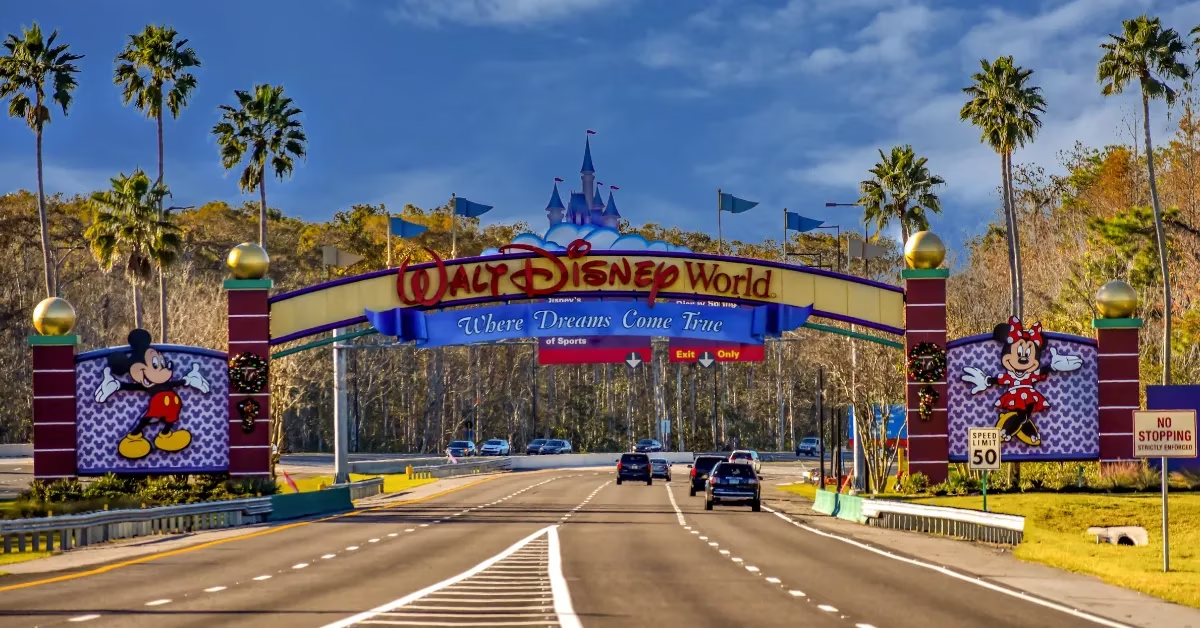
As a professional gamer, I've trained my eyes to spot visual artifacts and anomalous textures — the tiny glitches that reveal a developers' shortcuts. Yet here I was, duped by a photo that had all the subtle realism of a hastily modded Skyrim water plane. In the following hours, the fake flooded kingdom spread across social media like a contagion from an untouched zombie code, each share reinforcing the illusion. Friends posted it with broken-heart emojis. My guildmates, scattered across the country, messaged me to ask if I was safe from the “complete disaster.” The simulation was breaking, and I had bought a front-row seat to the breakdown.
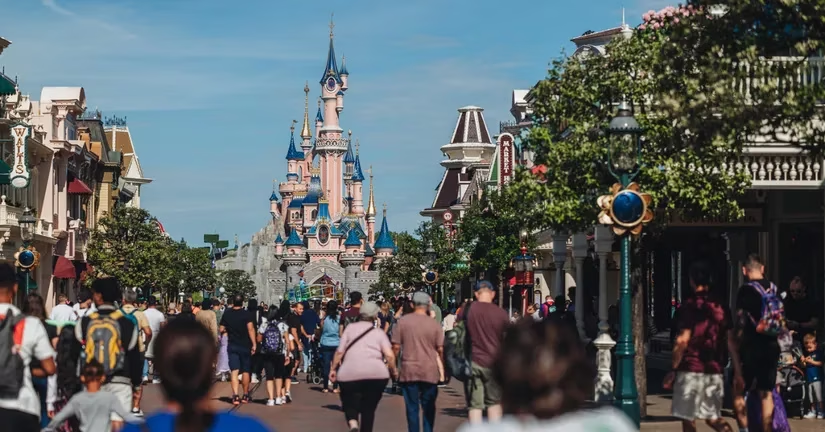
Truth trickled in slower than the storm surge. Walt Disney World had indeed closed its gates — only the twelfth time in fifty-three years — and a state of emergency stretched across Orange County. But the parks weren't underwater. They were standing exactly as they were designed to: defiantly dry, their secret engineering humming beneath the surface like a well-optimized game engine. I learned that the so-called "flooded Disney" photos were AI-generated fabrications, plausible only because Hurricane Milton's real violence made any horror seem credible. In reality, the park had evolved into something more akin to a hidden boss arena. The materials weren't merely decorative; they were a build order that prioritized durability. The EPCOT Building Codes of 1970, a legacy of foresight, demanded standards that exceeded traditional regulation, turning structures like the Tree of Life and Spaceship Earth into raid-worthy bastions.
I dove into the park's blueprint with the same obsessive energy I reserved for theorycrafting. The iconic Cinderella Castle revealed itself as a masterwork of resilience. It wasn't spun from wishful thinking but from concrete, steel, cement, plaster, and fiberglass — a composite armor that would make a MOBA tank envious. In 2021, an update added ten fiberglass ribbons, a patch designed specifically to counter hurricane-level threat, like a balance tweak for an overpowered environmental debuff. Disney had its own independent power source, a roguelike's backup generator for when the grid fails, and the location itself was chosen as if someone had scoured the map for the safest build spot to avoid natural disasters. The phrase “theme park” suddenly felt inadequate. This was a fortress-citadel, meticulously crafted to withstand the very calamities those AI images had falsely portrayed.
I started to see the entire event through the lens of my trade. The hurricane was an unscripted event, a server-wide catastrophe that forced all players to seek shelter. The viral AI images were corrupted data packets, misinformation procgen that hijacked our collective perception. And Disney World was the one reliable piece of hardware in an unstable system, a fixed asset whose collision box remained solid when everything else turned to liquid. My gamer instincts kicked in: verify the source code, check the official log. When Disney announced that its resort hotels would likely stay closed until October 13th and that cancellation fees were waived — “no cancellation or change fees imposed by Disney” — it was a clear development update. And when they contemplated opening Disney Springs late Thursday afternoon “with limited offerings,” it felt like an early access rollout after a massive crash fix.
Today, in 2026, that strange collision of reality, fabrication, and engineering still shapes how I experience both digital and physical worlds. I no longer trust a rendered scene just because it carries the emotional weight of plausible disaster. Every time I see a storm cloud massing over a virtual kingdom, I think of those fake flooded turrets and the real castle that stood unmoved behind them. Hurricane Milton taught me something crucial: the most compelling games, and the most startling headlines, are often built on carefully hidden structure. The art of resilience isn't flashy. It's a silent, optimized frame rate that never drops, even when the entire landscape screams in protest. And that, I've found, is the truest magic any kingdom can possess.
| Aspect | Viral AI Image Reality | Actual Disney Engineering |
|---|---|---|
| Cinderella Castle | Submerged, fragile spire | Steel, concrete, fiberglass ribbons (2021 update) |
| Park Grounds | Total flood, submerged landscaping | Durable materials meeting EPCOT 1970 codes; chosen location to avoid disasters |
| Animal Kingdom's Tree of Life | Underwater, ruined | Engineered to withstand massive storms |
| Operational Stability | Shut down permanently in image | Own power source; 12th closure in 53-year history, reopening assessed in stages |
| Guest Safety | No response visible | Waived cancellation fees; phased opening of Disney Springs |
😮 Did the AI-generated disaster images cause you a moment of panic too? I bet your internal simulation briefly rebooted, just like mine did. The good news is that the real EPCOT codes are arguably more impressive than any mythical invincibility cheat. 😎